This post contains affiliate links. If you buy through them, I may earn a small commission at no extra cost to you.
Table of Contents
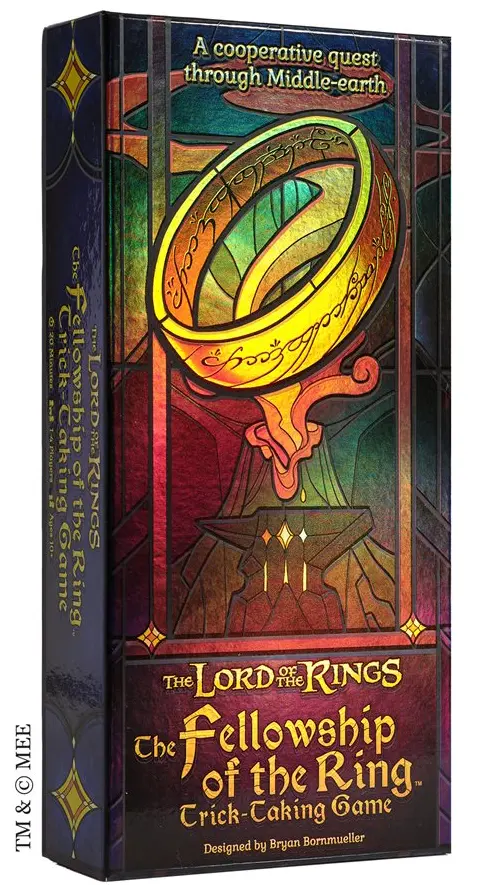
Overview
The Lord of the Rings: Trick-Taking Game takes a familiar card-game structure and wraps it in a cooperative narrative tied directly to the events of The Lord of the Rings. At its core, this is a cooperative trick-taking game where players work together to complete specific objectives across a series of chapters. If you’ve played modern cooperative trick-takers before, especially The Crew, you’ll immediately understand what this game is aiming for.
The result is an approachable, thematic, and gradually challenging experience that works best with a full table, even if it has a few quirks along the way.
Core Gameplay and Mechanics
The game uses a standard trick-taking foundation: players play one card per trick, must follow suit when possible, and the highest card of the led suit wins the trick. If you’re already familiar with trick-taking games like Spades, Hearts, or Euchre, the learning curve is minimal.
What changes things is the cooperative objective structure. Each chapter introduces specific win conditions tied to characters, card colours, or trick outcomes. You’re not trying to beat each other. You’re trying to collectively meet the chapter’s requirements, often under communication restrictions.
This cooperative angle is where the game shines. You’re constantly weighing whether to win a trick, deliberately lose one, or force another player to take control of a key moment. Success depends on timing, restraint, and reading the table rather than raw card strength.
Progressive Difficulty
One of the game’s strongest design choices is its progressive difficulty. Early chapters are intentionally simple, acting as a tutorial without feeling like one. They introduce new rules and twists gradually, allowing players to build confidence before things get more demanding.
As the game progresses, chapters start layering additional constraints:
- More complex objectives
- Tighter margins for error
- Greater reliance on indirect communication
- Increased punishment for misplays
This escalation feels natural rather than artificial. You’re rarely blindsided by difficulty spikes, but you will fail chapters if you’re careless or overly aggressive. That trial-and-error loop fits the cooperative structure well and encourages replaying chapters to refine strategy.
The Lord of the Rings Theme
The connection to The Lord of the Rings is handled thoughtfully. This is not a reskin where character names are pasted onto generic mechanics. Each chapter aligns loosely with moments, journeys, or themes from the story, and character roles feel purposeful rather than decorative.
That said, you don’t need deep Tolkien knowledge to enjoy the game. Fans of the books and films will appreciate the references, but mechanically, the game stands on its own. The theme enhances immersion without becoming a barrier to entry.
It also helps that the narrative progression mirrors the difficulty curve. As the Fellowship’s journey grows more perilous, so do the challenges you face as players.
Cooperative Trick-Taking Done Right
Cooperative trick-taking is still a relatively niche design space, and this game handles it well. Much like The Crew, the tension comes from limited communication. You can’t openly discuss your hand, which forces you to signal intent through play.
This leads to satisfying moments where:
- A player sacrifices a strong card to protect an objective
- Someone perfectly times a trick win without explicit coordination
- The table collectively groans when a single mistake derails a chapter
These moments are the heart of the experience. When things go right, it feels earned. When they go wrong, it’s usually obvious why, which makes regrouping and retrying less frustrating.
Player Count and Best Way to Play
The game supports 1–4 players, but support doesn’t equal recommendation.
At 3 or 4 players, the game works best. Each player manages their own hand, table dynamics feel natural, and the cooperative puzzle unfolds organically.
At 1 or 2 players, you’re required to control additional hands. Mechanically, this works, but experientially, it’s weaker. Managing multiple hands removes uncertainty and reduces the sense of shared discovery. It turns a cooperative card game into more of a solo puzzle, which misses the point for me.
If you have the option, play with at least three players. That’s where the game feels alive.
The Card Design Issue
One genuinely odd design choice deserves calling out: card orientation.
In most card games, you can fan your hand in any orientation and still clearly see card values at the top. Here, the cards don’t work that way. If you rotate them or fan them differently, the information becomes harder to read.
This doesn’t break the game, but it’s a constant low-level annoyance. It’s especially strange because trick-taking games thrive on quick visual parsing of your hand. It feels like an unnecessary deviation from a solved design standard.
Once you adjust, it’s manageable, but it’s still a baffling choice.
Comparison to The Crew
Comparisons to The Crew are inevitable, and largely fair.
Both games:
- Are cooperative trick-taking experiences
- Use progressive missions
- Restrict communication
- Reward precision and restraint
Where The Lord of the Rings: Trick-Taking Game differentiates itself is theme and accessibility. It leans more heavily into narrative framing, which some players will prefer. The difficulty curve also feels slightly gentler early on, making it easier to introduce to newer players.
If you liked The Crew, this is an easy recommendation. If you bounced off The Crew because it felt too abstract, the Lord of the Rings theme may help pull you in.
Who This Game Is For
This game is a strong fit for:
- Fans of trick-taking games
- Players who enjoy cooperative puzzles
- Lord of the Rings fans looking for a light but thoughtful card game
- Groups that enjoy replaying scenarios to improve performance
Final Thoughts
The Lord of the Rings: Trick-Taking Game is a smart, approachable cooperative card game that builds steadily toward more demanding challenges. It’s easy to learn, satisfying to master, and thematically well integrated.
The unusual card orientation is a strange misstep, and low player counts are less engaging, but neither is enough to derail the experience. Played with three or four players, this is a genuinely fun and rewarding cooperative game that sits comfortably alongside modern classics like The Crew.
If you enjoy trick-taking and want something cooperative with a clear sense of progression, this is well worth your time.